Repost from Predictive History: China's Third Center Strategy
Original source link: https://predictivehistory.substack.com/p/chinas-third-center-strategy
China's Third Center Strategy
China has hosted Trump, and will now host Putin. As the United States and Russia become more overt enemies, China seeks to be a friend to both.
Last week, I discussed why Trump visited China:
What would a grand bargain between China and the United States look like? The United States is primarily interested in maintaining dollar hegemony, and so it needs China to purchase US treasuries. China wants access to the US market as well as the energy resources of the Western hemisphere.
The summit has ended, and we are already seeing the broad contours of this grand bargain emerging. China has agreed to buy American LNG, and China agrees with Trump that Iran should not develop a nuclear weapon, should not close the Strait of Hormuz, and should not collect tolls.
President Xi Jinping calls for “strategic stability” between China and the United States, which I interpret to mean that both should co-operate to maintain the status quo. This is a tacit acceptance of the Donroe Doctrine, and America’s supremacy over the Western Hemisphere and America’s war against Iran. China accept America’s subjugation of Venezuela and strangling of Cuba, and China hopes that America concludes its “business” in the Middle East as soon as possible.
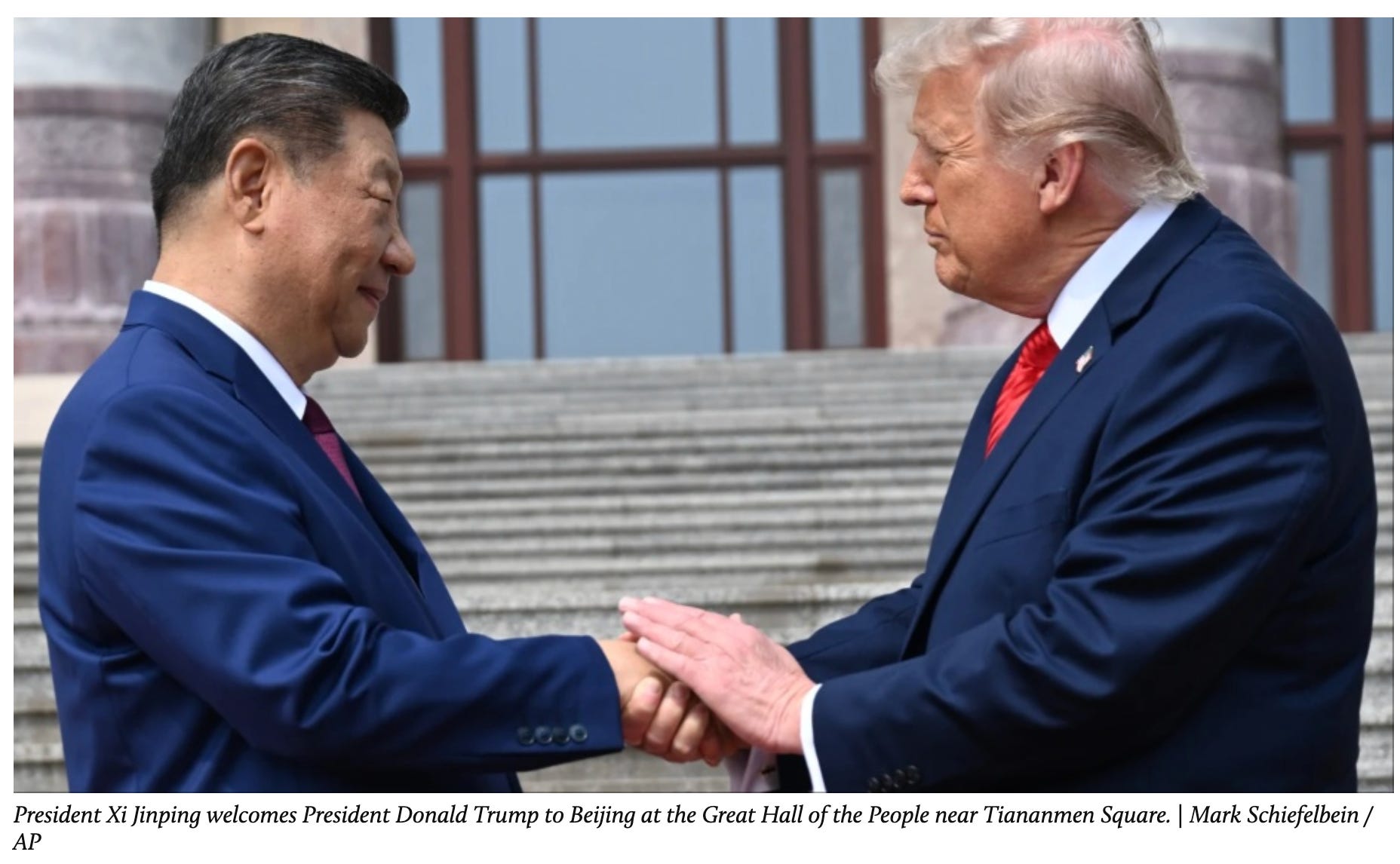
In return, Trump seems ready to “oppose” Taiwan independence, arguing it is a distant concern in an interview with Fox News’ Bret Baier. He has yet to approve the $12 billion arms sale to Taiwan. He wants to transfer Taiwan’s semi-conductor industry to America, and Taiwan Semiconductor Manufacturing Corporation (TSMC) is obliging by expanding its operations in the United States. The United States has tried to onshore manufacturing with little success, and Trump wants to lure the Chinese manufacturing base to America. There’s a rumor circulating that the Chinese plan to invest one trillion dollars in American manufacturing.
In an interview with Sean Hannity, Trump has said that he wants 500,000 Chinese to study in America, and he will allow Chinese to buy American farmland. He claims that this is to save American colleges from bankruptcy, and farmland value from declining. As I pointed out in my Substack last week and in my most recent YouTube lecture, the main reason is to distribute a portion of the $39 trillion dollar debt to the Chinese. Eventually, I believe that Beijing will allow Chinese to purchase stable-coins (digital currency backed by US treasuries), which would allow them to participate in the US economy without causing the RMB to free-fall.
Both Xi and Trump signaled that they have reached a grand bargain in their speeches at the state banquet Thursday evening. It was the first and only time that both leaders read prepared remarks, and the speeches seemed to synchronize with each other. Both said that the two countries have a long historical friendship, and that their cultures complemented each other.
Xi said that Trump was making America great again, and called for “strategic stability”:
Our two countries should be partners rather than rivals. President Trump and I also agreed to build a constructive China-US relationship of strategic stability to promote the steady, sound, and sustainable development of China-US relations and bring more peace, prosperity, and progress to the world.
Trump’s remarks were more revealing:
Chinese workers helped lay the railroad tracks that connected our Atlantic coast to the Pacific. American travelers to China helped spread literacy and modern medicine, and at the request of China’s ambassador, it was President Theodore Roosevelt who provided the funds to establish President Xi’s alma mater, Tsinghua University.
As allies in World War II, President Franklin Roosevelt’s mentions of the brave people of China, that’s what they were, through loud cheers and his speeches in the United States, and everybody loved what he had to say, just as many Chinese now love basketball and blue jeans, Chinese restaurants in America today outnumber the five largest fast food chains in the United States all combined.
That’s a pretty big statement. This bond of commerce and respect that stretches back 250 years is the foundation for a future that benefits both of our nations. The American and Chinese people share much in common, we value hard work, we value courage and achievement, we love our families, and we love our countries.
Trump’s ultimate ambition is to turn North America into a self-sufficient continental fortress, and he wants the Chinese to build the infrastructure and manufacturing base of this Greater North America. In return, the United States will build American college franchises in China. Think how excited ordinary Chinese will be at the prospect of a Yale or Harvard campus in China.
What gives Trump the confidence that this grand bargain will work out is the fact that the United States and China share a “fake it until you make it” hustler culture. That’s why both Trump and Elon Musk — the two most outrageous carnival barkers in the world today — are rock star celebrities in China. When Trump was staying at the Four Seasons Hotel presidential suite in Beijing, thousands paid vigil in the hope of catching a glimpse of the great man. Always the showman, Trump kept the lights on all night, and the curtains opened.
The Chinese and Americans may not appreciate their natural affinity, but others do. In his 1997 book The Foundations of Geo-Politics, Alexander Dugin argued that both the United States and China are materialistic, secular, and crass civilizations that complement each other. In their 1989 essay “The Japan that Can Say No,” Japanese Transport Minister Shintaro Ishihara and Sony Chairman Akio Marita pointed out that China and America are destined to be friends because of their cultural similarities.
Trump fawned over Xi in their meeting, but when Japanese Prime Minister Sanae Takaichi visited Trump at the White House he embarrassed her by referencing Pearl Harbor. She requested a Trump stop-over in Japan, and he gave her a phone call.
There is much discussion online about the “Thucydides’ Trap,” an idea popularized by Graham Allison, Xi’s favorite historian. In his book The Peloponnesian War, Thucydides argued that Sparta had to go war against an ascendant Athens to protect its hegemony. He also argued that each nation has its own particular character that determines its behavior, and that is the real “Thucydides’ Trap.” It may be in the Chinese long-term strategic interest to work with the Russians against the Americans, but it is in their character to respect the Americans, and fear the Russians.
Powerful men are working behind the scenes to make this US-China grand bargain a reality. Elon Musk and Jensen Huang had the spotlight, but the financiers Larry Fink and Steven Schwarzman were the ones who made the trip possible. Chair of the World Economic Forum, Fink’s Blackrock is heavily invested in China. Schwarzman has access to the White House and Zhongnanhai, and donated $200 million to seed the Schwarzman Scholars program, China’s answer to the Rhodes Scholarship. The two sit at Tsinghua University School of Economics and Management Advisory Board, an exclusive club founded by Premier Zhu Rongji that directs US-China relations from the shadows. Other board members who were part of Trump’s entourage are Tim Cook of Apple, David Solomon of Goldman Sachs, and Jane Fraser of Citi. Members who did not join Trump on this trip, but who have influence in his administration include Ray Dalio, Jamie Dimon, Michael Dell, David Rubenstein, and Mark Zuckerberg. Their influence help us explain the complementary speeches of Trump and Xi at the state banquet.
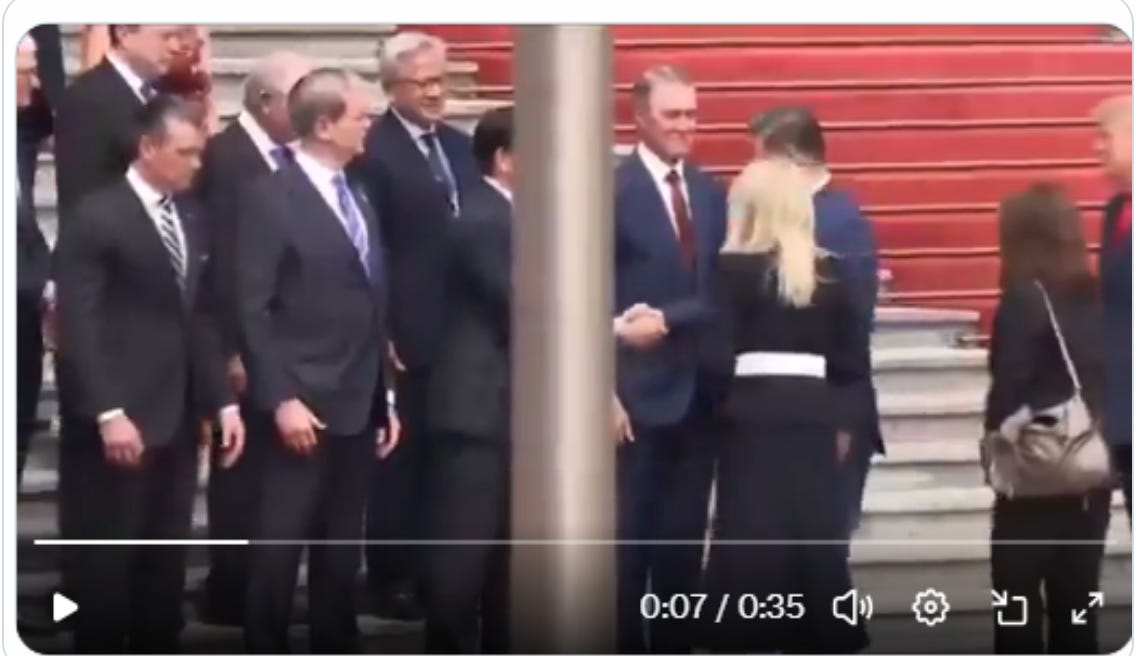
It was Trump’s Treasury Secretary Scott Bessent, a George Soros protege and experienced China hand, who organized the Trump-Xi summit. China hawk Marco Rubio was sidelined, even though as the Secretary of State and National Security Advisor he should have been the main organizer. As a troll, Rubio (who had been sanctioned twice by the Chinese) wore the same Nike tracksuit as Maduro when he was being transported to the United States. The Chinese showed a pole blocking Rubio’s face when he shook hands with Xi.
This begs the question: If this cabal is in charge of US-China relations, how did the trade war between the United States and China start in the first place?
To enter the World Trade Organization and achieve Permanent Trade Normal Relations (PTNR), China promised the United States it would stringently protect American intellectual property, and open its financial sector to Wall Street. President Xi’s “China Dream” called for a more nationalistic and assertive China. Huawei overtook a complacent Apple, and Wall Street lost influence. This ignited the trade war, which has hurt both nations. With the world in flames, China is looking to pivot to a Third Center strategy, in which it aims to triangulate between the United States and Russia, similar to how China was part of the “non-aligned” movement during the Cold War.
There are three main pillars to China’s Third Center strategy:
Focus entirely on national unity and cohesion. This includes opposing Taiwan independence, and promoting an AI surveillance state to crush any internal dissent.
Avoid foreign entanglements. This means refusing to take any sides in a conflict.
Focus on global trade. This means promoting business ties above all else.
In the short term, this means moving away from Russia and Iran, and seeking rapprochement with America. In the long term, this may mean China withdrawing from the world stage altogether, and leaving its entrepreneurs to their own devices.
During this transition, China must maintain a delicate balance, and avoid taking sides and offending anyone. That is why Trump seemed so obsequious to Xi, and why Xi seemed so aloof. Trump was giving face to his adversary in order to secure the deal. China did not want to be seen to be frustrating Trump’s ambitions in any way. Huawei, BYD (Elon Musk’s Chinese competitor), and Deepseek (OpenAI’s Chinese competitor) were not invited to the state banquet.
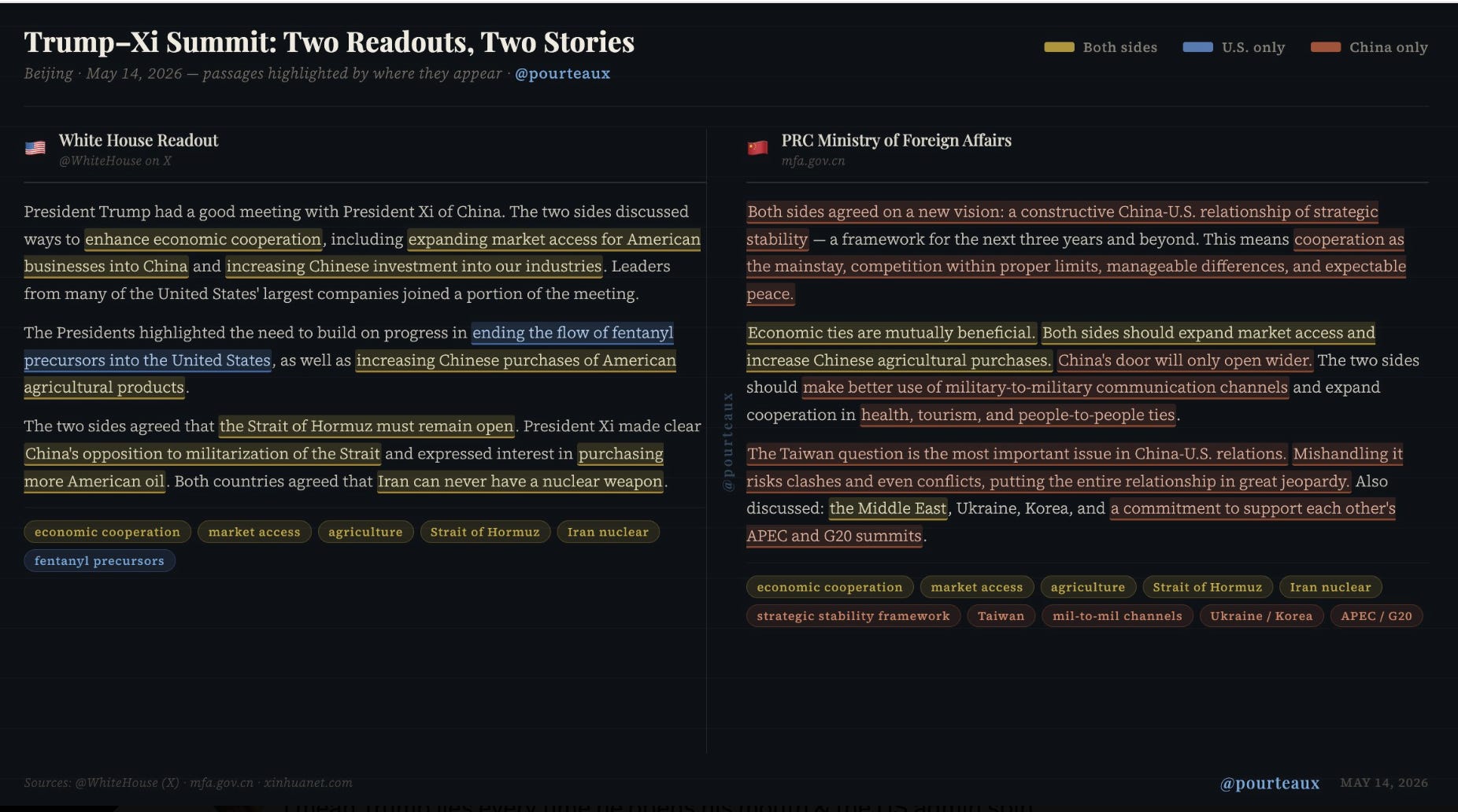
This helps us understand why the Americans and Chinese frame the visit outcome so differently. Whereas the Americans would rather focus on Chinese support for their efforts in Iran, the Chinese focus on resolving the Taiwan question.
China’s Third Center strategy is why the Chinese will prepare a lavish welcome for Putin when he visits Beijing next Tuesday and Wednesday. Everyone will compare and contrast the two visits. Whereas Trump came as a defeated opponent, Putin will come as a triumphant friend. There will be smiles, promises of eternal friendship, and staggering energy deals. Whereas Xi emphasized “strategic stability” with Trump, he may want to emphasize “strategy unity” with Putin.
Both the Russians and the Iranians know what’s up. That’s why Putin wants to visit China, and why the Iranians are now allowing the Chinese to freely bypass the Strait of Hormuz.
To maintain the Third Center doctrine of “balance and harmony,” we can expect the Chinese to still provide financing and goods to the Iranians in their struggle against the Americans. But we can also expect the Chinese to lobby hard for the Iranians to take a deal.
I am curious as to how Putin will respond to China’s Third Center strategy. He is a strategic genius, and his next move may surprise everyone. We’ll have to wait and see.
Next week, Putin enters the chat.
Comments
Post a Comment