Repost by Predictive History: The US-China Grand Bargain
Original source: https://substack.com/home/post/p-196967913?source=queue
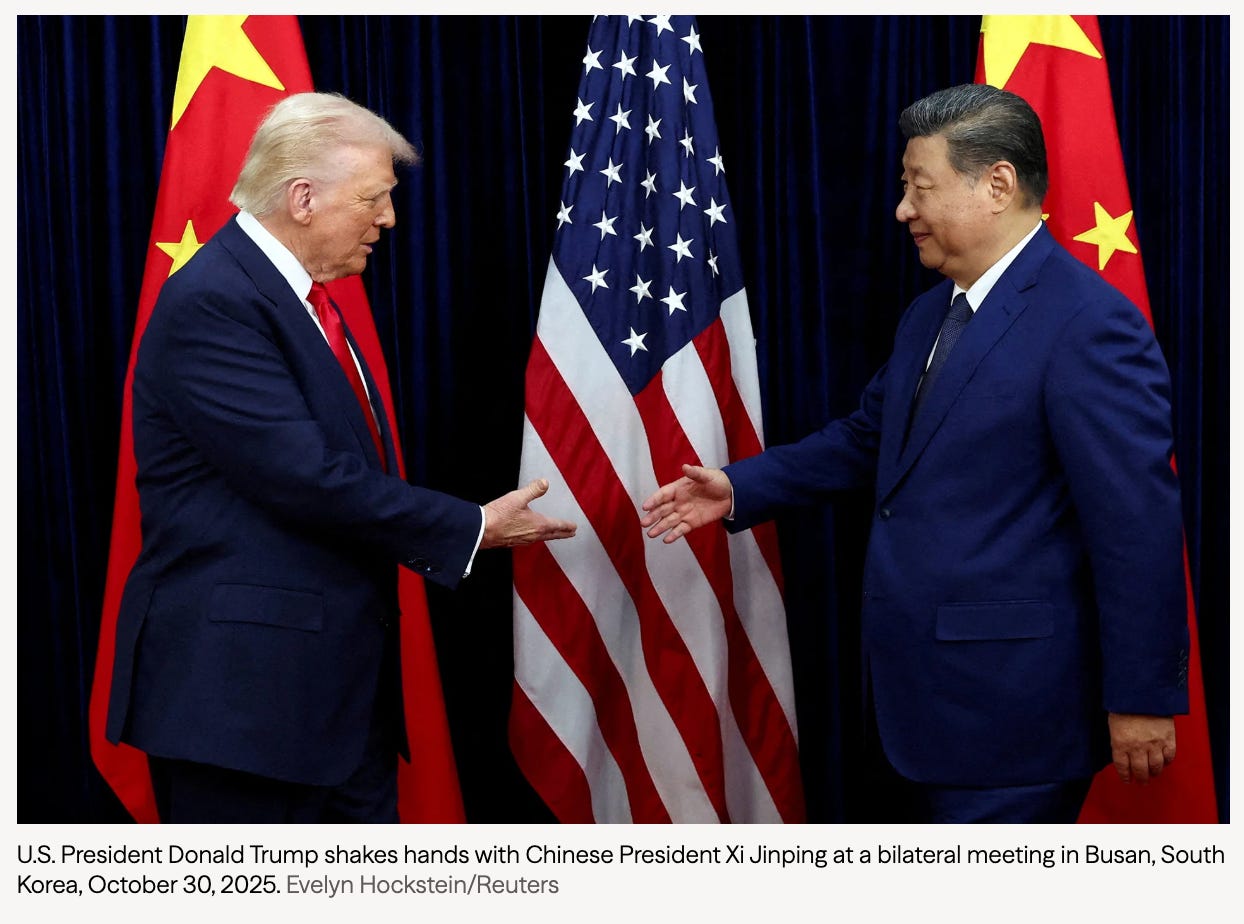
Next week, American President Donald Trump will visit Beijing for two days. The last time an American President visited Beijing was when Trump visited in November 2017. That reciprocated Chinese Xi Jinping’s April 2017 state visit to the United States, where Trump’s grandchildren recited Tang Dynasty poetry for him.
Afterwards, there followed a rapid deterioration in US-China relations:
In January 2018, Trump accused China of stealing intellectual property, and began imposing tariffs on China. This started a trade war that became institutionalized under Biden.
In December 2018, Canada detained Huawei executive Meng Wanzhou because the United States requested her extradition. In response, China arrested two Canadian nationals, and accused them of spying.
In January 2020, the United States canceled its Peace Corps program in China.
In March 2020, the United States limited the number of journalists from certain Chinese state media. China retaliated by expelling journalists from the New York Times, Washington Post, and Wall Street Journal.
In June 2020, Trump blamed China for spreading Covid-19 to the United States, and called it the “kung-flu.”
In July 2020, the United States ordered China to close its Houston consulate. China retaliated by ordering the United States to close its Chengdu consulate, and Chinese netizens petitioned for the consulate to be turned into a hot pot restaurant called “Trump Hot Pot.”
In his first term, Trump’s actions against China seemed calculated to be personal. In his second term, Trump has opted for a softer approach with China, and it seems his animus is now directed at Europe and the Democrats. The two main architects of Trump’s China strategy in his first administration — deputy national security advisor Matt Pottinger and senior counsellor for trade and manufacturing Peter Navarro — are not present in his second.
There is hope that Trump will repair the damage to US-China relations that he wantonly created in his first term, and I believe that a grand bargain between the United States and China is afoot. This is counter-intuitive, as most people believe that China aims to displace Pax Americana with Pax Sinica.
This fundamentally misunderstands the nature of the Chinese political system. To put it in the bluntest terms, the United States is democratic, and maintains political stability by exploiting other populations to benefit its own. China is authoritarian, and maintains political stability by exploiting the population to benefit the political elite.
The political systems of the United States and China complement each other, and they are both status quo powers that benefit from a global economy under heavy strain. Presidents Trump and Xi are expected to meet four times this year, and we should expect these meetings to be fruitful.
Throughout the US-Iran War, China has maintained neutrality, even though the United States is the aggressor and Iran is an important hub in the Belt and Road Initiative. Iranian Foreign Minister Abbas Araghchi was recently in Beijing to meet with Chinese Foreign Minister Wang Yi, and many analysts believe China will shore up its support for Iran. Yes, it is true that Araghchi was invited to China, and the Chinese treated him cordially. But in diplomacy it’s more important to appreciate contrasts.
When Aragchi visited Russia right before China, President Putin talked with him for 90 minutes. Putin conveyed support and sympathy to the people of Iran:
“We see how courageously and heroically the Iranian people are fighting for their independence and sovereignty. And, of course, we very much hope that, relying on this courage and determination for independence, the Iranian people, under the leadership of their new leader, will go through this difficult period of trials and that peace will come.
For our part, we will do everything that meets your interests and the interests of all peoples in the region in order to ensure that this peace is achieved as quickly as possible. You are well aware of our position.”
In contrast, China prioritizes the opening the Strait of Hormuz, and aims to be a neutral mediator, as outlined in President Xi’s four-point proposal:
adhere to the principle of peaceful coexistence.
adhere to the principle of national sovereignty.
adhere to the principle of international rule of law (such as free maritime navigation in the Strait of Hormuz).
adhere to the principle of diplomacy to mediate disputes.
As someone who lives in China, let me translate what this means: “We do not care how this war started, but we want the conflict and the suffering to end, which means re-opening the Strait of Hormuz as soon as possible.”
In his meeting with Chinese Foreign Minister Wang Yi, Araghchi acknowledged China’s position by emphasizing that Iran is trying as hard as possible to seek a diplomatic solution to the war. Wang Yi emphasized that diplomacy is the only solution, and that China will facilitate diplomacy among all parties.
The moment that Aragchi left Beijing on May 7th, four American senators arrived in Beijing for talks. The bi-partisan group met with Chinese Premier Li Qiang, National People’s Congress Chairman Zhao Leji, and Foreign Minister Wang Yi. Chinese media reports that the group aimed to lay the groundwork for Trump’s visit, and thanked China for working hard to resolve the Strait of Hormuz issue.
We should not forget that Trump was supposed to visit China at the end of March, but Trump delayed his trip because of the war. Trump asked China not to supply weapons to Iran, and China insisted it has not done so.
According to the Chinese Foreign Ministry press release, Wang Yi emphasized to the American delegation that China does not seek global hegemony, and is entirely focused on its own national development:
“China will not follow the obsolete model of a country seeking hegemony when growing stronger. It will remain committed to peaceful development and stay firmly on the path of socialism with Chinese characteristics.”
Also, consider how Trump imposed sanctions on five Chinese refineries of Iranian oil. In response, China’s Ministry of Commerce “blocked” these sanctions, and ordered Chinese companies to not comply. Analysts believe that this shows that American sanctions no longer have any teeth, but that interpretation fails to appreciate the nuance and subtlety of the Chinese response. First, China’s actions were “blocking” rather than “retaliatory.” This allows the United States to ignore that the Chinese are ignoring their sanctions — similar to how the United States can pretend the “ceasefire” is holding despite the constant flare-ups. Second, that this “blocking” action is unprecedented tells us that for the most part Chinese institutions have complied with American sanctions, even when these sanctions were applied against Russia and Iran.
What would a grand bargain between China and the United States look like? The United States is primarily interested in maintaining dollar hegemony, and so it needs China to purchase US treasuries. China wants access to the US market as well as the energy resources of the Western hemisphere.
Accompanying Trump in his visit will be the CEOs of Nvdia, Apple, Exxon, Boeing, Citigroup, Visa, Qualcomm, and Blackstone. This is a far more impressive list of business executives than those who accompanied Trump in his 2017 visit when American business executives became disillusioned with the China market.
This 2026 list of CEOs offers some insight as to what deals may be negotiated.
Boeing CEO Kelly Ortberg anticipates that China may buy as many as 500 Boeing 737 planes, which would be Boeing’s largest sale since 2017. This sign of goodwill on the part of the Chinese would help restore Boeing’s reputation, which has been battered over the years because Boeing’s planes are accident-prone.
Why are so many American financial institutions interested in China? They seek to claim China’s biggest prize, which is its average 40 percent household savings rate, the highest in the world. Access to the savings of the Chinese people will permit the US to better finance its $40 trillion debt. China would never surrender its financial sovereignty, and allow USD-RMB convertibility. One possible work-around is for private US corporations (such as Apple, Visa, Citigroup, and Blackstone) to sell stable-coins (digital currency backed by US treasuries) to Chinese consumers, who could then use it to participate in the US financial system, to buy US assets, and to send their children to study in the United States. Trump has discussed doubling the number of Chinese students in the US from 300,000 to 600,000.
It also makes sense that the CEO of Exxon will be joining this trip. Yes, it is true that China has made great strides in developing its renewable energy supply, but it still consumes almost twice as much electricity as the United States:
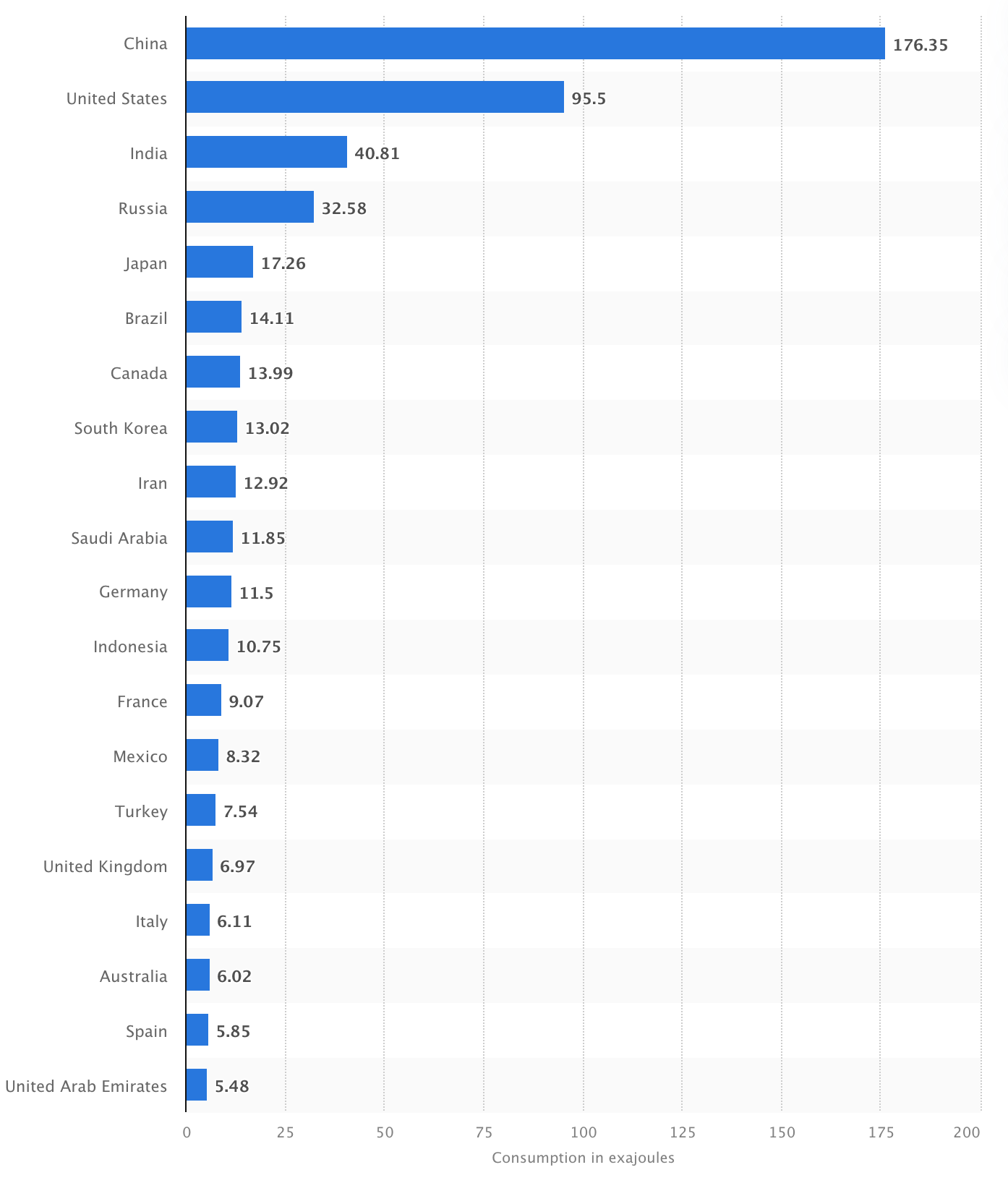
While Russia has abundant energy, it can only meet about twenty of China’s energy needs. With this war raging in the Middle East, China may have no choice but to buy more energy from the United States.
I talked with my wife about the US-China grand bargain, and she asks why China would agree to “ride or die” economically with the United States. My answer is simple: Because the Chinese economy is a creation of the United States, and therefore already tethered to it. As the global reserve currency, the USD gives value to all others; the RMB is only valuable because it can be exchanged for USD. If China and the United States were to fully de-couple, the Chinese economy would suffer far more than the American economy. If de-coupling is impossible, why not strengthen the relationship to benefit China politically?
Of course, all this is pure speculation on my part. It is possible that the meeting gets canceled at the last minute. Or the meeting goes well, and Trump increases economic pressure on China, as he did in his first term.
I believe that with Russia backing Iran, it makes strategic sense for Trump to seek a rapprochement with China, just like how Nixon did at the height of the Cold War. This does not mean that the United States and China become allies — it means that China maintains its neutrality, and seeks to do business with everyone. China will buy more energy from the United States and Russia, and it will increase its land-based trade with Iran to compensate for the American naval blockade in the Indian Ocean.
China will practice strategic patience, and continue to build its economic base, as Russia, Europe, Iran, Israel, and the United States exhaust themselves on the battlefield.
That is probably why Trump will do a stop-over in Japan before or after his China visit. China can afford to be patient, but Japan — with its demographic crisis, its waning economy, and its reliance on energy from abroad — cannot.
Comments
Post a Comment